
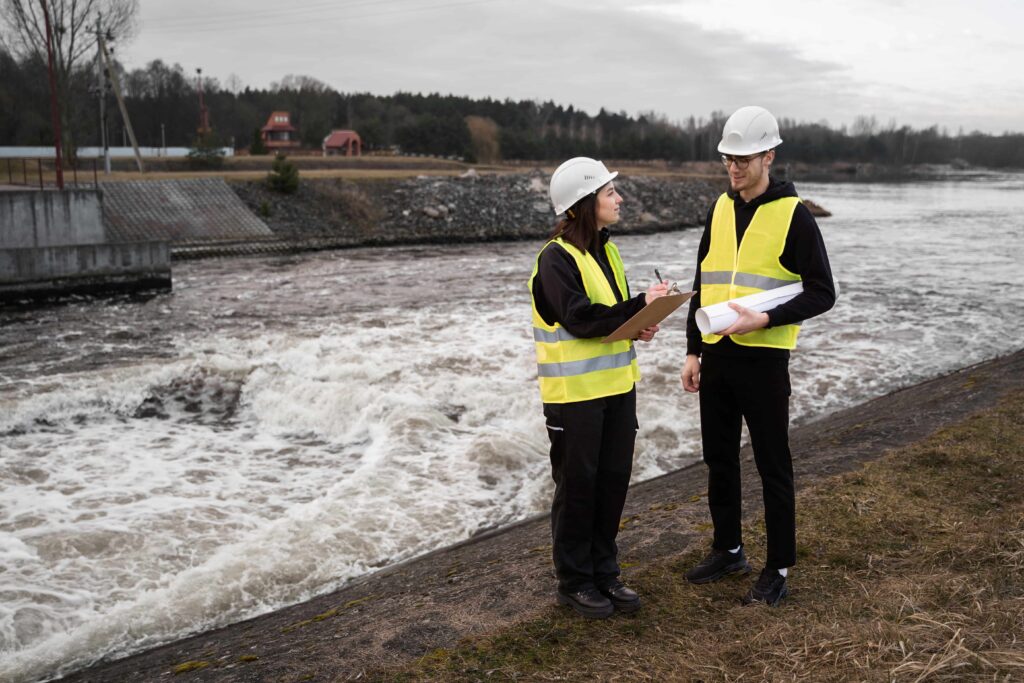
Effective stormwater management is critical across the United Kingdom, where urban development, environmental protection, and climate resilience increasingly intersect. Stormwater drainage costs represent a significant portion of many construction budgets, particularly on sites with complex runoff requirements, flood-risk constraints, or sustainability targets.
Accurate stormwater drainage cost estimation ensures drainage systems are compliant with UK regulations while remaining efficient, sustainable, and cost-effective. A structured, data-driven approach supported by Fast Estimator and detailed takeoffs improves budgeting, resource planning, and risk management—helping project teams avoid costly errors caused by underestimated scope or overlooked system complexity.
What Drives Stormwater Drainage Costs?
Stormwater drainage costs extend beyond pipe supply alone and include system design, installation, and long-term performance considerations. Key cost drivers include:
- System design complexity (traditional drainage versus sustainable drainage systems)
- Stormwater capacity requirements based on site runoff calculations
- Pipe materials (concrete, PVC, HDPE, vitrified clay, etc.)
- Inlet and outlet structures, including gullies, catch pits, manholes, and outfalls
- Granular materials such as gravel, sand, and filter media
- Labour costs for excavation, installation, and testing
- Site preparation, trenching, and reinstatement
- Permitting and environmental compliance
Each component contributes to overall stormwater drainage costs and must be accurately quantified during estimation.
The Role of Takeoffs in Stormwater Drainage Estimation
A detailed takeoff forms the foundation of reliable stormwater drainage cost estimation. Drainage systems involve extensive linear pipe runs, structures, and excavation works spread across large or constrained sites.
A typical stormwater drainage takeoff includes:
- pipe lengths by diameter, gradient, and material
- quantities of manholes, gullies, catch basins, and chambers
- excavation volumes for trenches and drainage features
- granular backfill and filter layers
- flow control systems such as attenuation tanks, swales, or soakaways
- reinstatement and compaction requirements
These takeoffs feed directly into Bills of Quantities (BOQs), ensuring stormwater drainage costs are transparent, measurable, and defensible.
UK-Specific Factors Affecting Stormwater Drainage Costs
Stormwater drainage systems in the UK are shaped by several location-specific challenges:
- High-density developments with limited space for drainage runs
- Strict planning and environmental requirements, including SuDS compliance
- Integration with existing or aging public drainage networks
- Flood-risk mitigation measures in designated flood zones
- Statutory approvals, inspections, and phased construction requirements
Accurate estimation using Fast Estimator ensures these factors are fully reflected in stormwater drainage cost planning.
Material Selection and Its Impact on Stormwater Drainage Costs
Material selection has a major influence on both capital and lifecycle costs. Different materials offer trade-offs between durability, performance, and installation complexity.
Key materials influencing cost include:
- PVC and HDPE pipes, offering flexibility and lower material cost
- Concrete and reinforced concrete pipes, providing durability for high-load conditions
- Permeable paving and infiltration systems that reduce runoff
- Manholes, chambers, and bespoke drainage structures
A disciplined takeoff must clearly differentiate material types, as unit rates, installation effort, and long-term maintenance costs vary significantly.
Labour Costs and Site Conditions
Labour is a major contributor to stormwater drainage costs, particularly on constrained or urban UK sites. Labour costs are influenced by:
- restricted site access and plant limitations
- trench depth and ground conditions
- productivity impacts from working around live services
- coordination with foundations, highways, and utilities
Linking labour assumptions directly to measured takeoff quantities improves productivity forecasting and cost reliability.
Labour and Installation Complexity
Labour is a major contributor to stormwater drainage costs, particularly on constrained or urban UK sites. Labour costs are influenced by:
- Restricted site access and plant limitations
- Trench depth and ground conditions
- Productivity impacts from working around live services
- Coordination with foundations, highways, and utilities
Linking labour assumptions directly to measured takeoff quantities improves productivity forecasting and cost reliability.
Integration with BOQs and Cost Control
Stormwater drainage cost management relies on well-structured BOQs. When developed from accurate takeoffs, BOQs support:
- Clear separation of materials, labour, and preliminaries
- Transparent tender comparisons
- Controlled variation pricing tied to quantities
- Staged cash-flow forecasting
For large UK infrastructure, residential, and commercial developments, BOQs are essential for maintaining cost control and financial accountability.
Digital Tools Supporting Stormwater Drainage Estimation
Digital tools such as BIM and 3D civil modelling platforms are transforming stormwater drainage estimation. Using Fast Estimator, project teams benefit from:
- Automated extraction of pipe and structure quantities
- Visual verification of drainage layouts
- Rapid updates following design revisions
- Coordination with structural, highways, and MEP systems
Digital workflows improve accuracy, speed, and responsiveness throughout the design and construction process.
Sustainability and Stormwater Drainage Systems
Sustainability plays an increasingly central role in UK stormwater drainage design. Sustainable Drainage Systems (SuDS) are now common across many developments.
Common SuDS elements include:
- Rain gardens and landscaped swales
- Green roofs for stormwater retention
- Permeable pavements
- Bioretention and filtration systems
Estimating these solutions requires specialist takeoffs for planting, soil layers, membranes, and drainage media. While initial costs may be higher, long-term benefits often include reduced infrastructure demand and improved environmental performance.
Risk and Contingency Planning in Drainage Estimation
Stormwater drainage systems involve specific risks that must be addressed during estimation:
- Unforeseen ground conditions or groundwater
- Changes during planning or regulatory approval
- Weather-related delays during excavation
- Access constraints affecting plant and delivery
Effective contingency planning ties these risks to quantified takeoff assumptions within Fast Estimator, rather than relying on generic allowances.
The Future of Stormwater Drainage Cost Estimation
The future of stormwater drainage estimation in the UK will increasingly involve:
- AI-driven runoff and site analysis
- Real-time quantity and cost updates
- Advanced hydraulic and retention modelling
- Deeper integration with BIM and digital twins
These developments will further improve accuracy, reduce uncertainty, and support better decision-making for complex drainage projects.
Conclusion
Stormwater drainage costs are a critical component of construction budgeting across the United Kingdom. Given the regulatory requirements, sustainability goals and site-specific challenges, accurate estimation is essential.
By leveraging disciplined takeoffs, structured BOQs, and digital workflows powered by Fast Estimator, project teams can control costs, manage risk, and deliver stormwater systems that are compliant, resilient, and sustainable. In today’s UK construction environment, precision in stormwater drainage estimation is not optional it is fundamental to project success.