
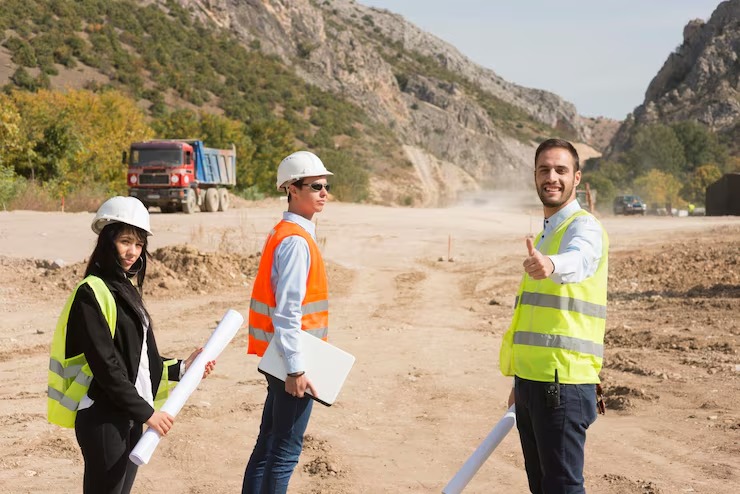
Before foundations are installed or structures begin to rise, the ground must be properly prepared to support construction safely and efficiently. In the UK, where sites are often constrained, uneven, or previously developed, site leveling costs represent a critical early component of overall project budgets. Errors at this stage can lead to structural issues, drainage problems, and costly delays later in the construction process.
Accurate planning of site leveling costs requires a clear understanding of ground conditions, soil characteristics, regulatory requirements, and site logistics. It also depends heavily on measurable data generated through a structured takeoff, ensuring that earthworks are planned and priced based on real quantities rather than assumptions., Fast Estimator.
What Are Site Leveling Costs?
Site leveling costs cover the activities required to prepare land to a uniform and stable elevation suitable for construction. Proper leveling ensures that foundations, pavements, and underground services can be installed correctly and safely.
Typical scope elements include:
- Stripping topsoil and unsuitable material
- Cutting high areas and filling low areas
- Rough grading and fine grading
- Compaction and density testing
- Disposal or reuse of excavated material
- Preparation for foundations and ground slabs
Each of these elements contributes to overall site leveling costs and must be carefully evaluated during early project planning.
Why Site Leveling Is Complex in the UK
Unlike greenfield developments, many UK construction projects involve brownfield or redevelopment sites with limited space and surrounding constraints. Several factors increase the complexity of site leveling works:
- Restricted space for cut-and-fill balancing
- Existing buildings and underground services
- Variable soil conditions, including made ground
- Environmental controls for noise, dust, and vibration
- Coordination with neighbouring properties and highways
These conditions mean site leveling cannot be treated as a simple bulk earthworks exercise. Accurate estimation must reflect actual construction constraints and methods, Fast Estimator.
The Role of Takeoffs in Site Leveling Cost Estimation
A disciplined takeoff is the foundation of reliable site leveling estimation. Earthworks are volume-driven, and even small measurement errors can result in significant cost differences.
A typical site leveling takeoff prepared by Fast Estimator includes:
- existing and proposed ground levels
- cut and fill volumes
- material import and export quantities
- compaction requirements by area
- haul distances and disposal volumes
These takeoffs allow estimators to calculate site leveling costs using measurable scope, supporting accurate budgeting and programme planning.
Key Cost Drivers in Site Leveling
Several variables strongly influence site leveling costs on UK projects:
- Soil type, including rock or unsuitable material
- Balance between cut and fill volumes
- Plant and equipment selection
- Site access and working space limitations
- Environmental controls and mitigation measures
- Testing and inspections required by local authorities
Identifying these cost drivers early enables project teams to manage risk and avoid unexpected increases during construction.
Cut-and-Fill Strategy and Cost Control
Balancing cut and fill is one of the most effective ways to control site leveling costs. Where suitable, reusing excavated material reduces haulage, disposal, and import costs.
Accurate takeoffs help teams:
- Identify opportunities for on-site material reuse
- Minimise off-site disposal
- Reduce vehicle movements and disruption
- Align grading strategy with foundation design
This data-driven approach improves both cost efficiency and environmental performance.
Integration with Other Early Works
Site leveling is closely coordinated with other early-stage construction activities, including:
- Trenching and backfilling
- Utility installations
- Surface water drainage
- Foundation excavation
Coordinated takeoffs across these scopes prevent duplication and ensure site leveling costs align with the overall earthworks strategy, Fast Estimator.
Labour, Plant, and Productivity Considerations
Labour and plant costs account for a significant portion of site leveling budgets. Productivity varies based on site size, access, and ground conditions.
Effective estimation considers:
- Machine grading versus manual works
- Available space for plant manoeuvring
- Safety measures near existing structures
- Sequencing to minimise rework
Linking productivity assumptions directly to measured quantities improves the reliability of site leveling cost forecasts.
BOQs and Cost Transparency
Structured Bills of Quantities (BOQs) play an important role in controlling site leveling costs. When developed from accurate takeoffs, BOQs allow:
- Clear separation of cut, fill, and compaction activities
- Transparent tender comparisons
- Variation pricing based on actual quantities
- Progress tracking against completed earthworks
This level of clarity is particularly valuable on UK projects subject to contractual and regulatory oversight.
Digital Tools Supporting Site Leveling Estimation
Modern site leveling estimation increasingly relies on digital terrain models and civil design software. These tools support:
- Automated earthworks takeoffs
- Accurate cut-and-fill analysis
- Rapid updates when site designs change
- Visual verification of grading plans
For complex UK projects, digital workflows help maintain control over site leveling costs throughout design development.
Risk and Contingency Planning
Site leveling carries inherent risks that must be reflected in estimates, including:
- Unforeseen ground conditions
- Contaminated or unsuitable soils
- Weather impacts on grading and compaction
- Changes in foundation or finished floor levels
Effective contingency planning links these risks to specific takeoff assumptions rather than generic allowances, improving predictability.
Sustainability and Environmental Considerations
Sustainability increasingly influences how site leveling costs are assessed. Estimators may evaluate:
- Reuse of excavated materials
- Reduced haulage to lower emissions
- Erosion and sediment control measures
Accurate takeoffs allow teams to balance cost efficiency with environmental responsibility.
The Future of Site Leveling Cost Estimation
The future of site leveling cost estimation will be driven by data and automation, including:
- AI-assisted terrain and survey analysis
- Automated takeoff generation from survey data
- Predictive modelling for ground risk and productivity
- Integration of cost, programme, and environmental metrics
These developments will further reduce uncertainty during early project stages.
Conclusion
Site leveling costs are a fundamental element of construction budgeting in the UK. Because they directly affect safety, drainage, and structural performance, accuracy at the estimating stage is essential.
By grounding estimates in disciplined takeoffs, structured BOQs, and digital workflows, Fast Estimator helps project teams control cost, manage risk, and set projects up for success from the ground up. In the UK’s challenging construction environment, precision in site leveling estimation is not optional it is essential.